After I refused to let my brother and his family use my beach house, my mother poured beer over my head at my own birthday dinner.
The celebration took place at a seafood restaurant in Cape May, New Jersey. String lights hung over the terrace, twenty relatives sat at long wooden tables, and my chocolate birthday cake was waiting near the bar.
My name is Claire Bennett. I was thirty-six years old, and the beach house everyone wanted from me was a small blue cottage I had bought myself after eleven years working as an insurance adjuster.
It was not inherited.
It was not shared.
It was not “family property.”
And it was definitely not extra real estate waiting to be claimed by whichever relative complained the loudest.
My older brother Daniel had three children, a wife named Kendra, and a long history of turning every bad financial decision into an emergency the rest of us were expected to fix.
Two months earlier, my mother had asked if Daniel’s family could “spend the summer there.” Later, Daniel admitted he actually meant they planned to move in permanently.
When I said no, my mother called me selfish. My father said I was being difficult. Daniel accused me of putting a house above family.
Then came my birthday dinner.
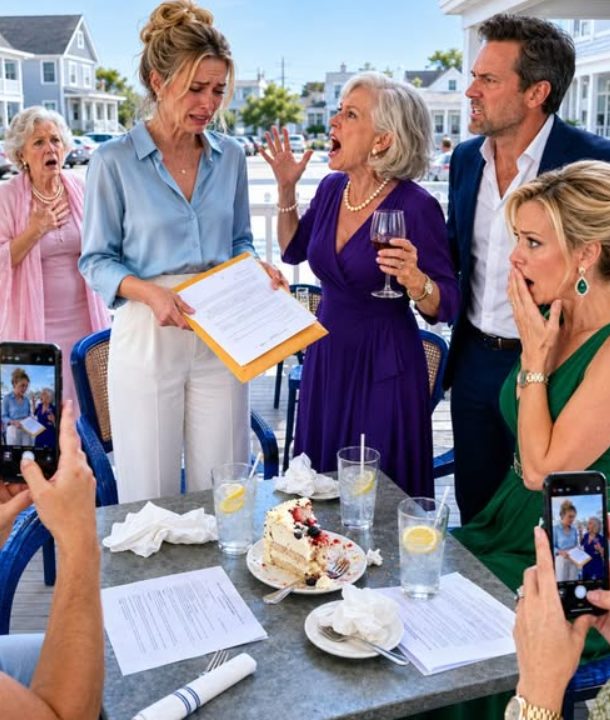
For dessert, my mother stood up with a bottle of beer in her hand and loudly asked, “How long are you going to stay this selfish?”
Before I could respond, she tipped the bottle over my head.
Beer soaked my hair, my blouse, and the birthday sash my niece had tied to my chair.
The entire terrace went silent except for the sound of beer dripping onto the wooden floor.
Kendra covered her mouth with her hand, but Daniel grinned, as if my public humiliation had finally satisfied him.
My mother pointed at me and said, “Maybe now you’ll understand what it feels like to abandon your family.”
I wiped beer from my chin and looked past her shoulder.
At the next table sat Judge Evelyn Harper, a retired family court judge who had once presided over an estate dispute for one of my deceased clients. She knew exactly why I had invited her. Family.
She was also the neutral witness my lawyer had advised me to bring, after Daniel threatened to “assert tenant rights” if he ever managed to get into my beach house.
Judge Harper slowly set down her fork.
Then she said, loud enough for everyone to hear, “Mrs. Bennett, you have just assaulted your daughter in front of a witness.”
The color drained from my mother’s face.
I reached into my handbag, pulled out the envelope my lawyer had prepared, and placed it on the table.
“Since everyone is watching,” I said, “we might as well talk about the real reason you wanted my beach house.”
Daniel’s smug grin disappeared the moment he saw the legal letterhead.
My mother reached for the envelope, but Judge Harper’s voice stopped her before her fingers could touch it.
“I strongly advise you not to interfere with documents following a public assault.”
My mother froze.
My father half stood from his chair and said, “This is a family matter, Evelyn.”
Judge Harper looked at him calmly. “No, Harold. A property deed, threats regarding unlawful occupancy, and an assault in a restaurant are not family matters just because the people involved are related.”
I opened the envelope and pulled out printed screenshots of Daniel’s messages.
One read: Once we move in, Claire won’t have the courage to kick the kids out.
Another said: Mom can guilt her until she signs something.
A third, from Kendra, said: Don’t tell Claire we already changed the school district forms to the beach address.
Kendra gasped when I read that line aloud.
Daniel snapped, “You had no right to look through private messages.”
“You sent them to our cousin by mistake,” I replied. “She had every right to warn me.”
Mom’s tearful expression turned angry. “You embarrassed your brother on purpose.”
I glanced down at my beer-soaked blouse and let out a short laugh, because humiliation was a strange word to hear from a woman who had just poured beer over my head at my own birthday party.
“No, Mom,” I said. “You chose the audience when you turned my birthday into a punishment.”
Judge Harper looked at Daniel. “Did you submit school paperwork using an address where you do not live and do not have permission to live?”
Daniel opened his mouth.
Then closed it.
His silence said more than any confession could.
My lawyer, Rebecca Sloan, arrived ten minutes later. She had been waiting in the parking lot, exactly as planned, because I had suspected my family might escalate.
She brought a formal cease-and-desist notice prohibiting Daniel, Kendra, my mother, and my father from entering, occupying, renting, listing, or using my beach house address for any reason.
My mother began crying harder. “Claire, please. Don’t ruin your birthday over this.”
I wiped beer from my sleeve and said, “You ruined the party. I’m protecting the house.”
The restaurant manager quietly came over and informed us that the security cameras had recorded everything.
That was when Daniel finally pushed his chair back.
“We’re leaving,” he said.
Judge Harper looked at him and replied, “Good. Before the police have to be involved.”
The next morning I filed a criminal complaint. Not because I wanted to drag my mother into court, but because my family had confused my patience with consent for far too long.
Rebecca filed the legal notice that same day and sent copies to Daniel’s landlord, the local school district, and the property management company that handled my beach house while I was away.
By noon, Daniel had called thirty-one times.
I didn’t pick up once.
Kendra sent a message saying the kids were devastated because they had already told their friends they were moving near the ocean.
I replied: “Then you shouldn’t have promised them a house you don’t own.”
My mother left a voicemail, sobbing that I had humiliated her in front of Judge Harper.
That was the first moment I understood that her concern was more about appearance than what she had done to me.
My father called later, gentler than usual, and asked if I could “let things settle.”
I told him, “Things settle when people stop taking my property.”
For two weeks, the family group chat was chaos.
Some relatives said I should forgive my mother because she had been emotional.
Others stopped defending her after my cousin revealed that Daniel had planned to move in first and ask permission later.
The school district rejected Daniel’s address change.
His landlord refused to terminate the lease without penalty.
Kendra eventually admitted they had already rented a moving truck for the following weekend.
That truth hurt them more than anything I could have said.
A month later, my mother asked to meet at a diner. Not at her home. Not at mine. Somewhere public, where she couldn’t rewrite the story afterward.
She looked older as she sat down across from me.
“I shouldn’t have poured beer over you,” she said.
I waited.
She swallowed. “And I should never have tried to make Daniel’s problems your responsibility.”
It wasn’t a perfect apology, but it was the first one that didn’t hide behind the word “family.”
So I accepted it.
But I did not withdraw the legal notice.
Daniel and Kendra stayed in their rental, enrolled their children in the district where they actually lived, and eventually stopped talking about my beach house as if it were an empty room waiting for them.
Later, Judge Harper sent me a handwritten note.
It read: “A boundary is valid without witnesses, but a witness can remind cowards.”
I framed that note in my home office.
As for the beach house, I spent the first week of the following summer there alone, painting the porch railings and drinking coffee before sunrise.
No one had a key.
No one had permission.
No one used the word “blood” when they meant free accommodation.
And every time I heard the waves roll in along the shore, I remembered beer dripping down my face at that birthday dinner.
My mother thought she was washing away my selfishness.
Instead, she washed away the last bit of guilt I had left about protecting what was mine.